Home › Katori Titanium Cutting Board Review
Katori Titanium Cutting Board Review 2026: Honest Pros, Cons & Verdict
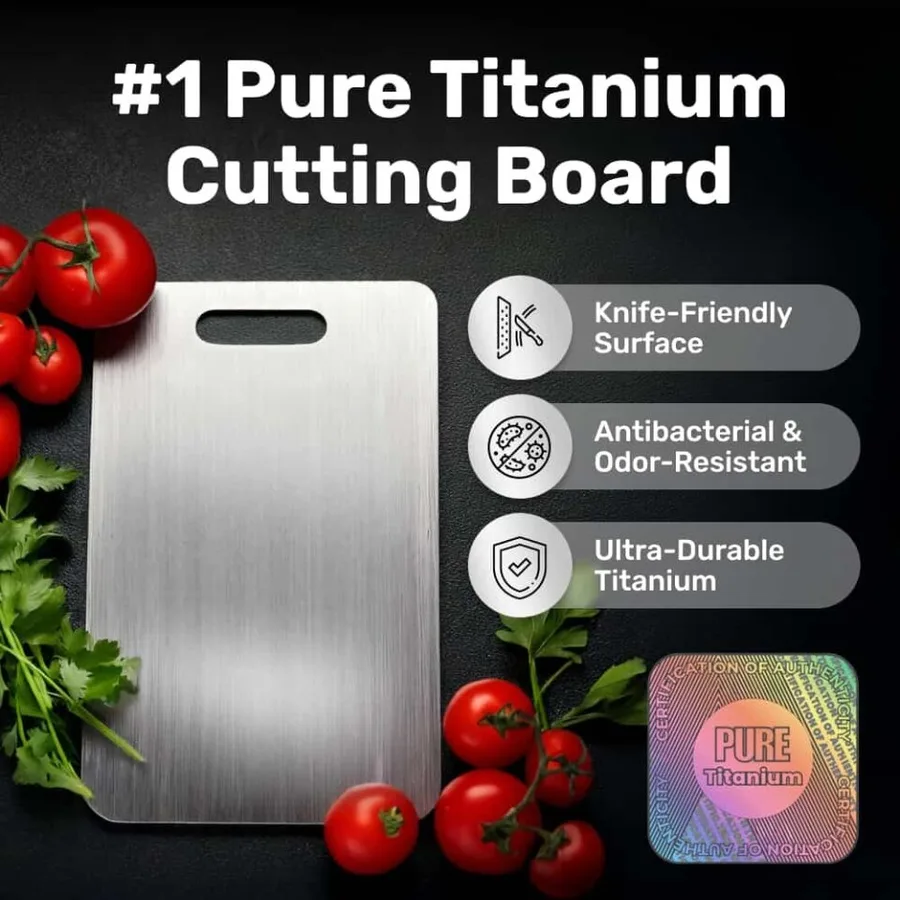
A genuinely hygienic, zero-maintenance prep board that solves the microplastic and bacteria problem for good. It is smaller and louder than a wooden block, and it slides on a wet counter, but it did not dull my knives and it still looks brand new after six weeks.
The Katori Titanium Cutting Board is worth buying if you want a board that cannot absorb juices, harbour bacteria or shed microplastics. It is non-porous, dishwasher safe and needs no oiling. Downsides are its compact 11.4 x 7.9 inch size, the metallic chopping noise, and sliding on wet counters.
Check Today's Price on the Official Site
30-day money-back guarantee · up to 70% off current promotion
What is the Katori Titanium Cutting Board?
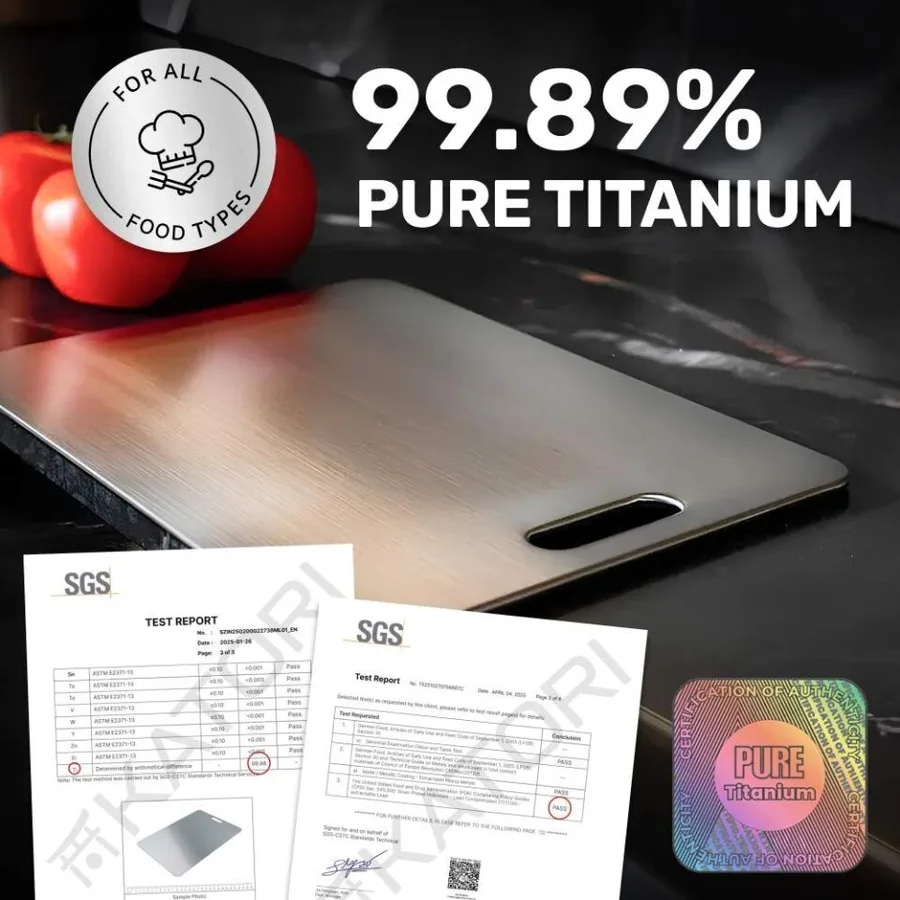
The Katori Titanium Cutting Board is a one-piece cutting board laser-cut from 99.89% pure food-grade titanium. It has no pores, no coating and no plastic core, so it cannot absorb liquid, stain, warp or shed particles into food. It is double-sided, dishwasher safe and measures 11.4 x 7.9 inches.
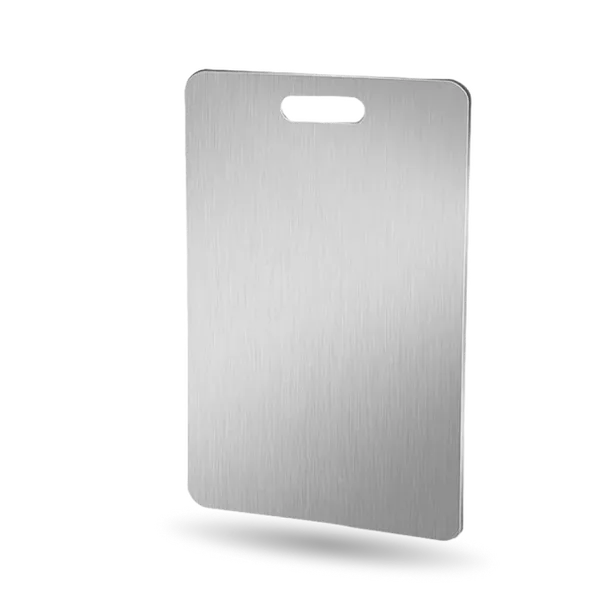
There is no laminate, no glue line and no non-stick layer that can peel. What you get is a single sheet of brushed titanium with rounded corners, an integrated hand grip cut into the top, and a matte finish on both faces so you can dedicate one side to raw protein and the other to produce.
Titanium is the same family of material used for surgical implants and aerospace parts, which is exactly why it works here: it does not corrode, it does not react with acidic food, and it does not host bacteria in the way porous surfaces do.
Why I tested it
I have been testing knives, boards and prep tools in my own kitchen since 2017, and cutting boards are the category I get asked about most. Not because people care about boards, but because everyone has the same nagging thought when they look down at a plastic board covered in knife scars: where did all that plastic go?
My own boards were the usual mix. A bamboo one that had started to split along the glue line. Two plastic ones that had turned grey and never quite lost the smell of onions. When titanium boards started flooding my feed with claims about microplastics, I was sceptical enough to buy one and use it as my only board for six weeks.
Specs and what is in the box
| Material | 99.89% pure food-grade titanium (Grade 1) |
| Dimensions | 11.4 x 7.9 in (29 x 20 cm) |
| Design | Double-sided, integrated hand grip, rounded corners |
| Cleaning | Dishwasher safe, rinse-clean, no oiling required |
| Certification | SGS lab-tested for purity and heavy metal migration |
| Contains | No BPA, no plastic, no nickel alloys, no coating |
| Guarantee | 30-day money-back guarantee, direct from the brand |
| Sold via | Official Katori website only |
How it works and why titanium instead of steel
Titanium forms a thin oxide layer on its surface that reseals itself when scuffed. That layer is inert, non-porous and corrosion proof, so bacteria have nothing to colonise and acidic foods cannot react with the metal. Stainless steel is harder and blunts knives faster; titanium here is heat-treated to stay knife-friendly.
This is the point most people get wrong. "Metal board" sounds like it should destroy knives, and with steel, stone or glass that is exactly what happens: the surface is harder than the blade, so the edge rolls and dulls fast.
Katori's titanium is heat-treated to sit below the hardness of hardened knife steel. The blade sinks in a fraction of a millimetre instead of skating across, which is the same mechanic that makes plastic boards knife-friendly, minus the shedding.
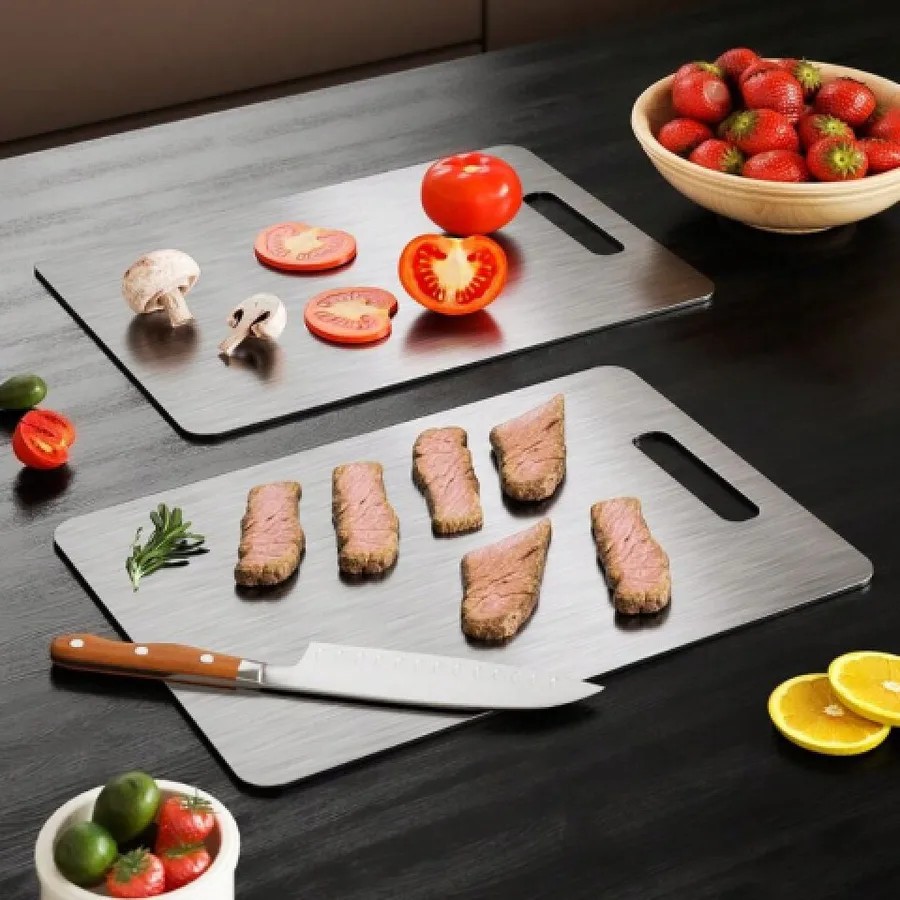
The double-sided layout does the other job. One face gets raw chicken and fish, the other gets vegetables, bread and fruit. Because the surface holds nothing, a rinse between uses is genuinely enough.
Six weeks of testing: what actually happened
Knife edge
This was the make-or-break test. I used a Japanese gyuto and a cheap German chef's knife, and I honed on the same schedule I use with plastic. After six weeks both knives were where I would expect them to be. No rolled edges, no chipping, no accelerated dulling. My knives fared measurably worse in the past on a glass board within a single week.
Hygiene and odor
Garlic, raw chicken, salmon, turmeric, beetroot. After a rinse, nothing lingered. That sounds like a small thing until you compare it with the bamboo board sitting next to it, which still carried a faint fish smell the following day. There is nowhere for residue to hide, so there is nothing to scrub out.
Cleaning
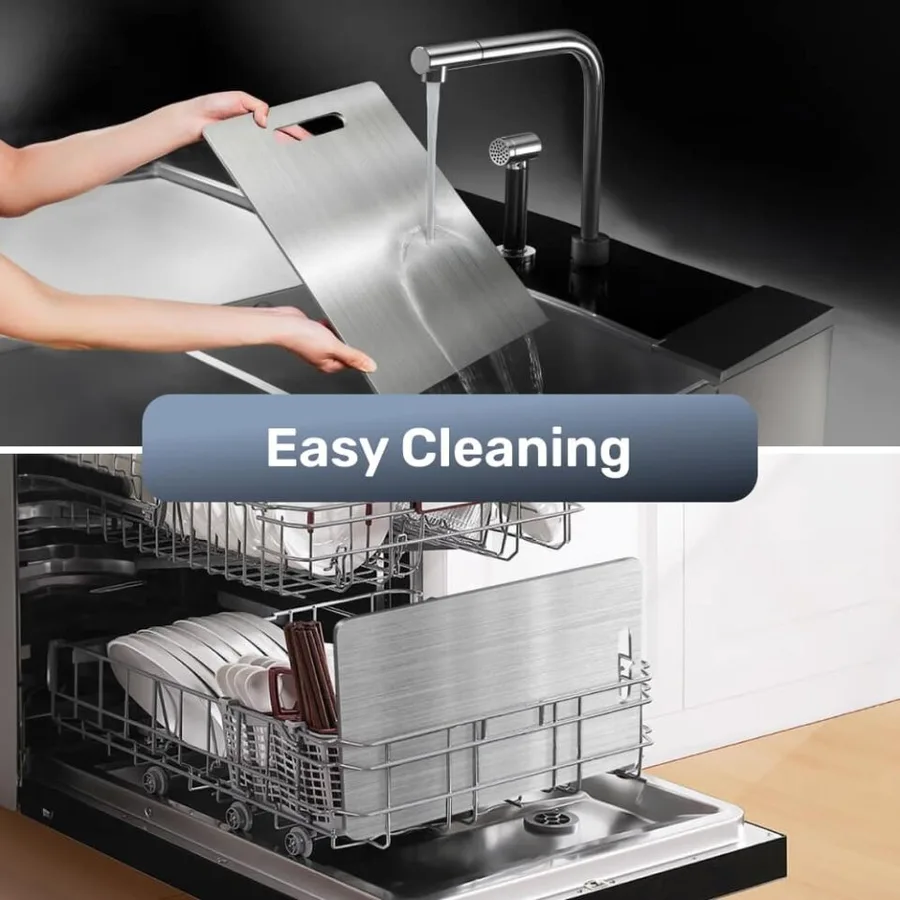
Ten seconds under the tap for produce, dishwasher after raw meat. No oiling, no bleach soak, no drying rack because it dries almost instantly. This alone removed a chore from my week.
Wear
Six weeks in, the surface shows light hairline marks under direct light and nothing else. No grooves you can catch a fingernail in, which is the whole point: no grooves means no bacterial trenches and nothing to release into food.
Noise
It is louder than wood. Chopping produces a bright metallic click rather than a soft thud. I stopped noticing after about two weeks, but if you prep early in a quiet apartment, know this going in.
Sliding
On a dry counter it stays put. On a wet counter it slides, because it is thin and light compared with a wooden block. A damp dish towel underneath solves it completely, and that is what I do now by default. This is my main honest criticism.
My scores
Pros and cons
What I liked
- Zero absorption: no juice, no odor, no stains, ever
- No knife grooves forming, so no bacteria trenches
- Did not dull my knives over six weeks of daily use
- Dishwasher safe with no warping or cracking
- No oiling, waxing or conditioning of any kind
- Genuinely looks like it will outlive me
- Doubles as a serving platter straight to the table
- SGS purity testing published, not just claimed
What to keep in mind
- Slides on a wet counter unless you use a cloth or mat
- Noticeably louder to chop on than wood
- Compact 11.4 x 7.9 in, tight for large carving jobs
- Costs more upfront than a plastic board
- No juice well on the flat model, liquid can run off
- Cold to the touch, which some cooks dislike
- Aggressive countdown-timer marketing on the sales page
- Sold direct only, so no in-store try-before-you-buy
Who it is for, and who should skip it
✅ A good fit if you
- Worry about microplastics in your food
- Prep raw meat and fish regularly
- Keep replacing scratched plastic boards
- Hate maintenance routines like oiling wood
- Own good knives and want to protect them
- Camp, travel or meal prep in batches
❌ Probably not for you if you
- Love the sound and feel of a wooden block
- Break down whole poultry weekly and need a big surface
- Need a deep juice groove for carving roasts
- Cook early in a very quiet shared apartment
- Already own an end-grain board you maintain properly
- Want the absolute cheapest option available
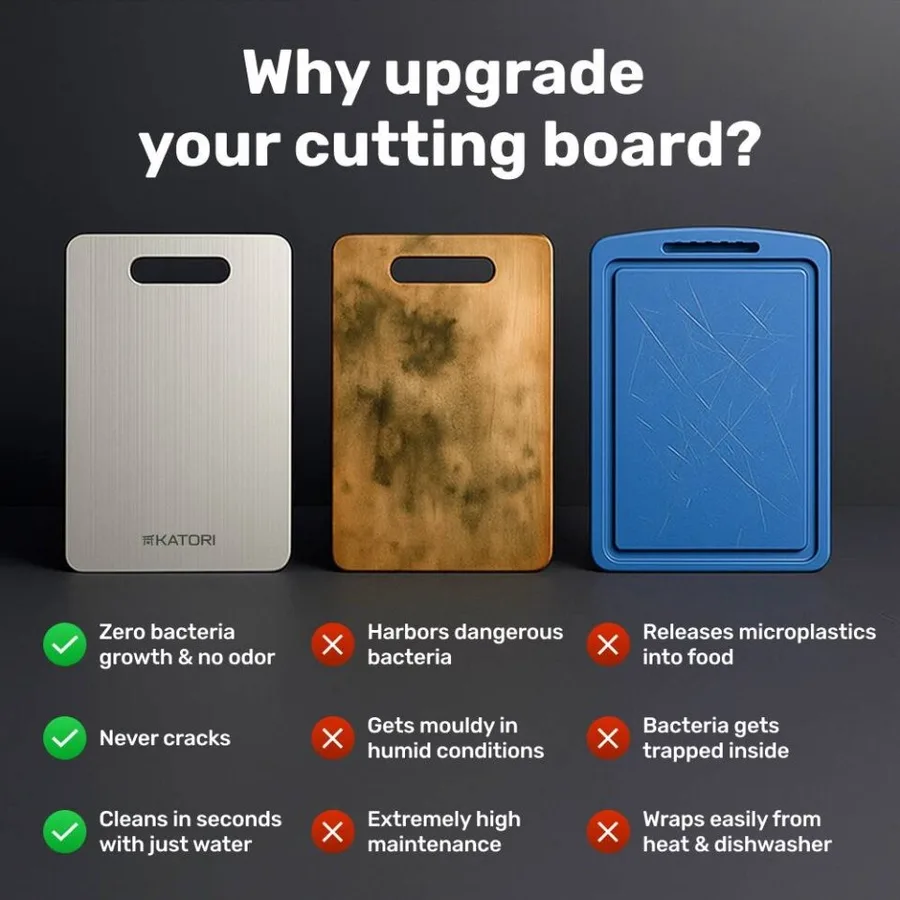
Katori vs wood, plastic and glass
| Feature | Katori Titanium | Wood / Bamboo | Plastic | Glass / Stone |
|---|---|---|---|---|
| Non-porous | Yes | No | No | Yes |
| Knife-friendly | Yes | Yes | Yes | No |
| No microplastic shedding | Yes | Yes | No | Yes |
| Dishwasher safe | Yes | No | Yes | Yes |
| Odor & stain resistant | Yes | No | No | Yes |
| Zero maintenance | Yes | No | Yes | Yes |
| Quiet to chop on | No | Yes | Yes | No |
| Lasts a lifetime | Yes | No | No | No |
The honest summary: titanium wins on every hygiene and durability metric, ties with wood and plastic on knife friendliness, and loses to wood on noise and warmth. Glass and stone lose badly on knife friendliness, which is why I no longer own one.
Pricing and the 30-day guarantee
Katori sells direct from its official website with rotating promotional pricing, currently advertised at up to 70% off, and larger discounts on multi-board bundles. Every order carries a 30-day money-back guarantee. Because the promotion changes frequently, the live price is shown at checkout rather than quoted here.
1 board
Try it in your own kitchen. Best if you just want to replace your main prep board.
2 boards
What I would buy. One for raw protein, one for produce, and no washing between tasks.
4 boards
Sensible for big households or if you are covering gifts for the year in one order.
Bundle structure and live pricing are set by the seller and confirmed on the official checkout page. I do not control or set the price.
How the guarantee actually works
You have 30 days from delivery to request a refund. Contact Katori support, request the return, and keep the original packaging: change-of-mind returns are processed more smoothly when the board can be sent back in its box. This is the standard direct-to-consumer arrangement and it means the risk of trying it sits with the seller, not you.
My recommendation
If you are replacing plastic boards on repeat, or you have been quietly uneasy about microplastics and raw-meat juice, this solves it permanently. Buy one, use it hard for 30 days, and send it back if it does not earn the counter space.
Check the Official Price & Current Discount30-day money-back guarantee · secure checkout · ships from the US